

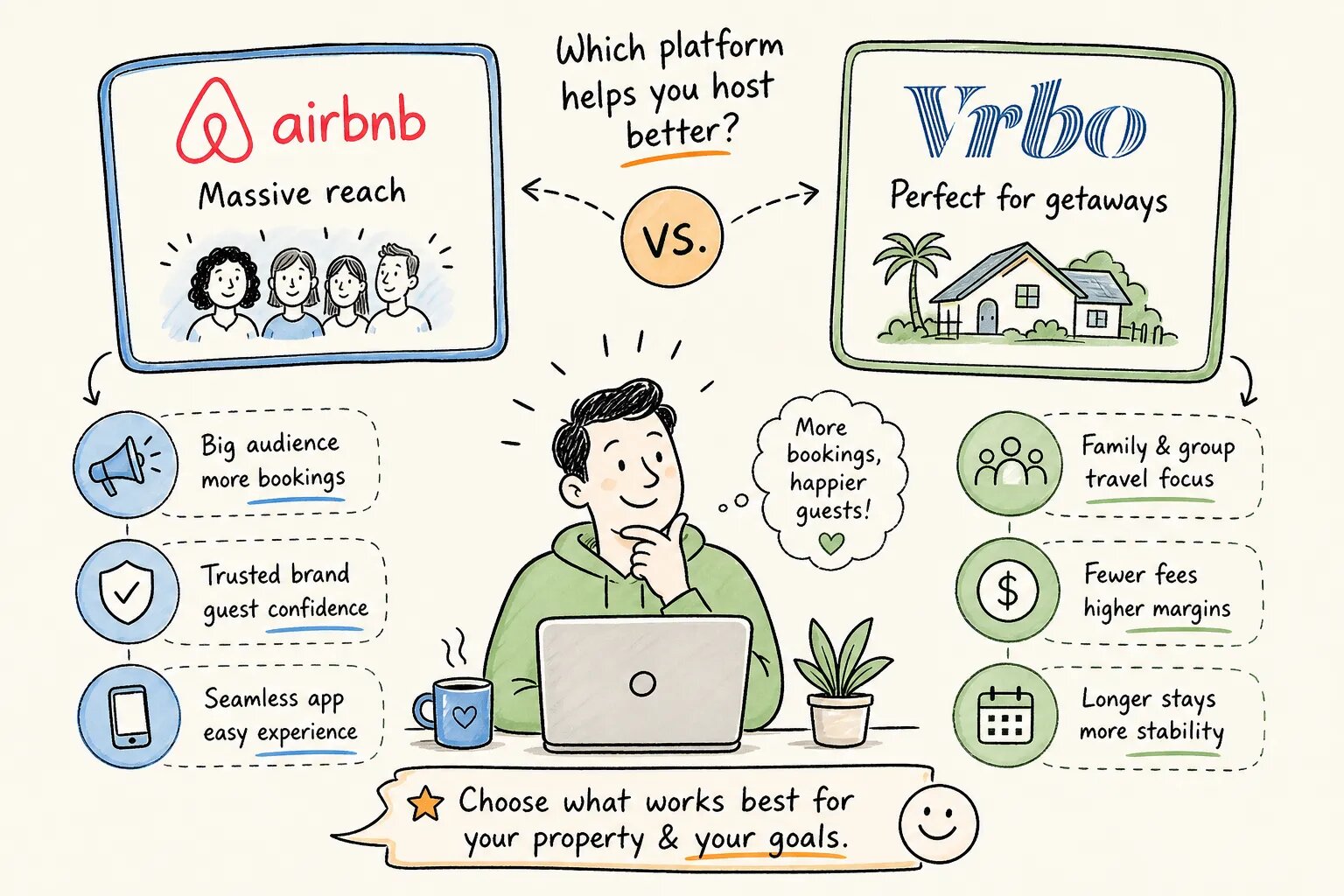
Choosing between Airbnb and VRBO affects what you earn, who books your home, and how you should design it. This guide compares the two platforms on fees, guest demographics, listing visibility and property fit, and it includes what hosts have reported about declining bookings on each.
Fees
Airbnb charges most hosts a single host-only fee of 15.5% of the booking subtotal, taken from the payout. Guests see no separate Airbnb service charge. In Brazil and Mexico the host fee is 16%.
VRBO charged most pay-per-booking hosts a 5% commission plus a 3% payment processing fee, roughly 8% in total, until October 29, 2026. From that date VRBO moves all hosts to a single 12% commission. VRBO says this rate includes payment processing for hosts who use its merchant services. Guests still pay a VRBO service fee, so compare the guest-facing total as well as the host payout.
Guest demographics
Airbnb draws the widest mix of guests, including solo travellers, couples, business guests and groups. It tends to win short stays and city bookings.
VRBO has historically attracted families and groups who plan trips in advance. Stays tend to be longer, which can reduce turnover costs.
Listing visibility
Both platforms rank listings on relevance, price, reviews and how often a listing converts. Photos do most of the selling on each site. A dark or cluttered listing will struggle on either platform.
Declining booking requests
This is where hosts most often run into trouble. Host discussions on Reddit describe a common situation: a guest sends a VRBO request that conflicts with the house rules, such as bringing a pet to a no-pets home. The host can't always find a decline button in the app, and some hosts report that an open request blocks their calendar.
Hosts in that thread recommend two steps. First, state your rules clearly in the listing and the house rules, since guests do not always read long listings. Second, if you must decline, contact VRBO support and ask for the booking request decline waiver so the decline doesn't count against your acceptance rate. Several hosts say this worked for them. Others report VRBO enforces its rules unevenly by region, so confirm the process before you need it.
Source: Reddit, r/vrbohosts, 2026 discussion on declining a pet request.
Which platform suits which property
Urban apartments and studios usually fit Airbnb better, because its audience searches city-first and books at short notice.
Large houses, lake homes and family properties often fit VRBO better, especially for stays of five nights or more.
Properties with unusual features are worth listing on both, then tracking which platform books them.
Market notes
Miami allows short-term rentals with a city business license, but some neighborhoods apply their own rules.
San Diego now licenses short-term rentals only for a host's primary residence, plus one additional unit on the same parcel. A nightly fee applies. Check your address before you invest.
Brazil charges a 16% host fee on Airbnb. Rules differ by city, so confirm municipal requirements first.
Regulations change often. Verify the current position with the city before you commit.
Design for the guest your platform attracts
The platform you choose shapes your design brief. VRBO's family audience responds to durable furniture, generous dining and kid-friendly storage. Airbnb's wider audience responds to a clear workspace, quality bedding and a calm bathroom.
Return to the Airbnb hosting and design guide.
Share this article & image
Social link previews use this article image when supported by the receiving app.
Continue exploring Airbnb hosting and design
Hosting and design notes in your inbox
Subscribe to the DNA Interiors newsletter for practical hosting resources.
Join the newsletter